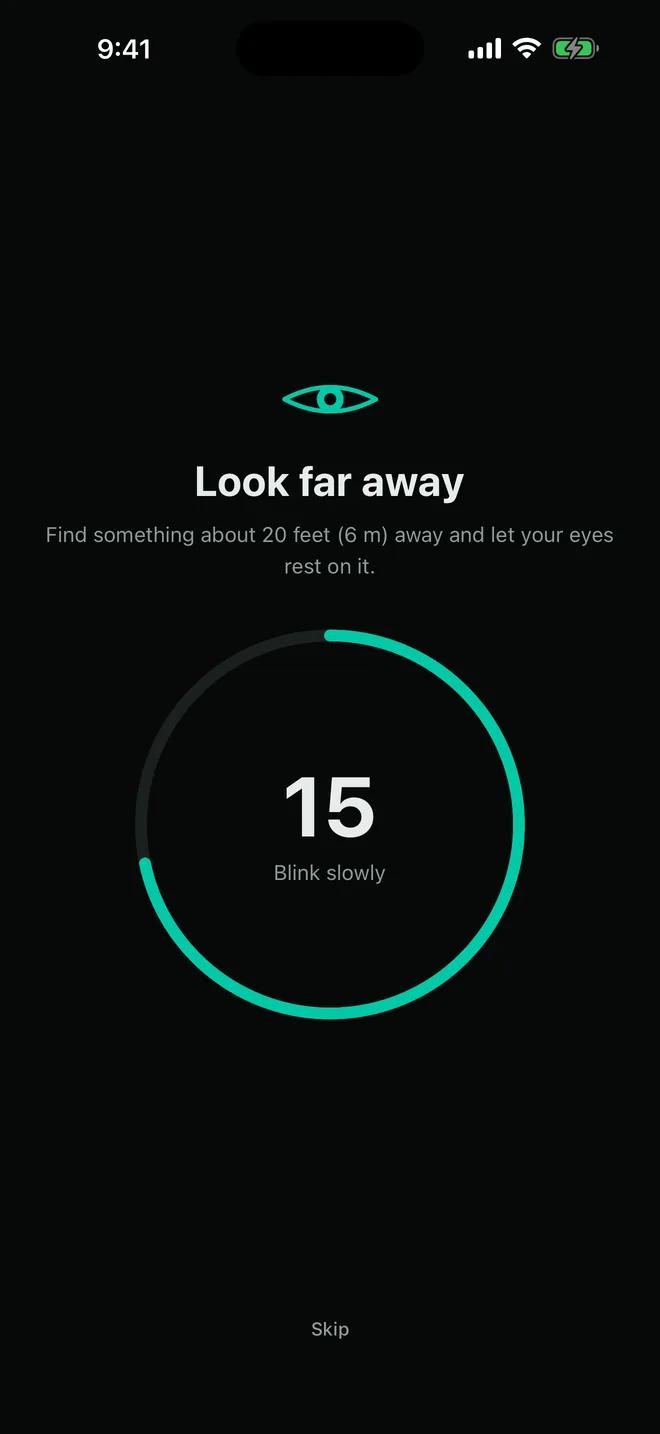
What the 20-20-20 rule says
The rule has three numbers, and each one is an instruction:
- Every 20 minutes of screen time,
- look at something about 20 feet away (about 6 metres, roughly the length of a large room),
- for 20 seconds.
The American Optometric Association (AOA) puts it like this:
“To help alleviate digital eyestrain, follow the 20-20-20 rule; take a 20-second break to view something 20 feet away every 20 minutes.”
Source: AOA, Computer vision syndrome. The rule is not a test or an exercise. It is a pause: for twenty seconds your eyes stop working at reading distance and rest on something far away.
Why looking away helps
Reading a screen keeps your eyes on one close distance for a long time. In the AOA's words, viewing a computer or digital screen “often makes the eyes work harder”.
We also blink less. The American Academy of Ophthalmology (AAO) says people normally blink about 15 times a minute, but only about 5 to 7 times a minute while using computers and other digital screens.
The AAO is also clear that looking at screens does not permanently damage your eyes. Long stretches can leave them feeling uncomfortable, though, and a regular look into the distance is the simplest break there is.
What the research says
Studies of the rule itself are small, and they don't all agree.
- In a 2023 study in Contact Lens and Anterior Eye, 29 computer users with symptoms ran software that reminded them to follow the 20-20-20 rule for two weeks. They took more breaks, and the eye strain and dry-eye symptoms they reported went down while the reminders were running. One week after the reminders stopped, the difference was gone.
- A 2023 study in Optometry and Vision Science with 30 participants found that 20-second breaks at different intervals during a 40-minute tablet reading task made no significant difference to the symptoms they reported.
The practical reading: treat the 20-20-20 rule as a comfort habit for long screen days, not a treatment, and expect it to help only while you keep doing it.
How to do the 20-20-20 rule at a desk
- Pick your far point before you need it. A window, the far end of the office, a building across the street. Deciding in advance makes the 20 seconds easy.
- When the reminder comes, look at it for the full 20 seconds. Let your eyes rest on it rather than reading anything.
- Blink slowly and fully a few times while you look.
- No far point? Look at the farthest thing you can see, or close your eyes for the 20 seconds.
Set up the desk too
- Distance: the AOA suggests 20 to 28 inches (about 50 to 70 cm) from your eyes to the screen; the AAO says about 25 inches, roughly arm's length.
- Height: the AOA suggests the centre of the screen about 15 to 20 degrees below eye level, around 4 to 5 inches lower than your eyes.
- Glare: the AAO suggests a matte screen filter if your screen reflects a lot of light.
- Longer breaks: the AOA also recommends resting your eyes for 15 minutes after two hours of continuous computer use.
The 20-20-20 rule on a phone or tablet
Phones are held closer than monitors and used in long, unplanned stretches: scrolling, reading, messaging. The same rhythm works. Every 20 minutes, look up and into the distance for 20 seconds.
- Hold the phone a little further away when you can.
- On iPhone and iPad, Screen Distance (Settings, Screen Time) uses the front camera to tell you when you hold the device closer than 12 inches for an extended period.
- Reading in bed or on a commute is screen time too. The rule applies there as well.
How to make it stick
The 20-20-20 rule is easy to understand and hard to keep up. Twenty minutes is long enough to forget and short enough to come round many times a day. What helps:
- Tie your eye rest reminders to your working hours instead of starting a timer each time.
- Use an eye break reminder you can act on in one tap, and that stays quiet outside your hours.
- Know your far point in advance.
- Keep the break short and the same every time. Twenty seconds is easy to say yes to.
- Keep a rough count. Seeing today's breaks is enough to notice when the habit slips.